
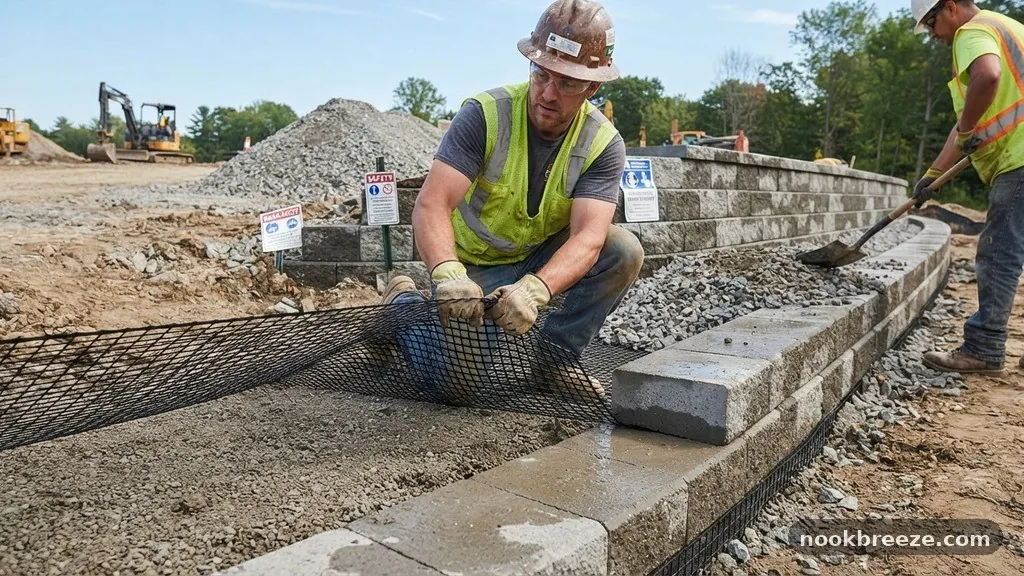
Tensioning Geogrid Before Backfilling Soil to Prevent Future Wall Tilt
Tensioning geogrid before backfilling soil to prevent future wall tilt is the most effective way to ensure the long-term structural integrity of your retaining wall. By removing slack from the reinforcement material prior to adding heavy fill, you minimize the initial movement that often leads to unsightly leaning or catastrophic failure.
This proactive approach locks the grid into the soil matrix immediately, allowing the system to resist lateral earth pressures from the moment construction concludes. Understanding these mechanical principles helps contractors and homeowners avoid the common pitfalls that cause walls to shift over time, ultimately saving significant repair expenses down the road.
Why Pre-Tensioning Matters for Stability

The primary function of geogrid is to provide tensile reinforcement to the soil mass, effectively turning loose dirt into a coherent, gravity-defying structure. If you lay the grid flat without applying tension, the wall must move slightly outward before the grid can engage with the soil. This initial displacement, even if seemingly minor, creates a gap between the facing units and the backfill.
Over time, this void allows water to accumulate, increasing hydrostatic pressure and accelerating the wall’s rotation. By tensioning the material manually, you eliminate that “slack” phase entirely.
The reinforcement starts working at its full design capacity the second the first lift of soil is compacted. This is the difference between a wall that settles into a stable position and one that continues to creep forward under its own weight.
Mechanical Principles of Soil Reinforcement
Retaining walls fail most frequently because of lateral earth pressure pushing against the back of the structure. Geogrids mitigate this by creating a reinforced soil mass that acts as a single, massive gravity block. When you pull the grid taut, you align the polymer ribs with the direction of the expected strain.
This alignment ensures that the tensile strength of the geogrid is mobilized immediately upon the application of external loads. Without this step, the soil near the wall face remains under-supported until the wall itself shifts enough to stretch the grid.
Engineering designs assume the grid is fully engaged; manual tensioning is the practical field application of that theoretical requirement. It turns the design into a reality, ensuring the soil and reinforcement function as one unified system.
The Risks of Skipping Tensioning

Neglecting to pull the grid tight allows for “creep,” a phenomenon where the wall face slowly moves away from the reinforced soil zone. This movement creates a shear plane where the wall can detach from the geogrid connection point. Once that connection is compromised, the wall loses its structural anchor and begins to tilt or bulge.
Bulging is often the first visible symptom, indicating that the soil behind the wall is pushing harder than the connection can withstand. If left unaddressed, this leads to structural cracking in the blocks or timber, requiring expensive remediation.
You can prevent this scenario entirely by ensuring the grid is pulled taut against the wall face before any backfill is placed. A few minutes of extra effort during the installation phase prevents years of maintenance headaches.
Step-by-Step Installation Process
Proper installation begins with a level base and a clean surface for the first layer of geogrid. Place your grid perpendicular to the wall face, ensuring it spans the required length back into the hillside. After securing the front edge to the wall unit, use a simple tensioning tool or manual force to pull the back end of the grid until it is completely flat and rigid.
Stake the back of the grid firmly into the subgrade using specialized pins or heavy spikes. This anchor point holds the tension while you place the first layer of aggregate or soil.
Always start compacting from the wall face and move backward, which helps maintain the tension you have already established. Using a Natural Resources Conservation Service guide on soil erosion and stabilization can provide additional context on how these materials interact with native ground types.
Selecting the Right Geogrid Type
Not all reinforcement materials are created equal, and your choice depends on the specific requirements of your project. Uniaxial geogrids are designed to provide strength in one direction, making them ideal for retaining walls where the primary stress is perpendicular to the wall face. Biaxial grids offer strength in both directions, which is often useful for base stabilization or road construction.
When selecting a product, look for data on the tensile modulus and aperture size. Larger apertures allow for better interlocking with aggregate, which is essential for maximizing the friction between the soil and the grid. You should consult the manufacturer’s specifications to ensure the material matches your local soil conditions and the height of your proposed wall.
Comparison of Common Grid Materials
| Material Type | Primary Use | Tensile Strength | Installation Ease |
|---|---|---|---|
| Uniaxial Polymer | Retaining Walls | High (One-way) | Moderate |
| Biaxial Polymer | Base Stabilization | Medium (Two-way) | High |
| Composite Grid | Slope Reinforcement | Very High | Low |
Managing Drainage and Hydrostatic Pressure

Even with perfectly tensioned geogrid, a wall will fail if water is allowed to build up behind it. Hydrostatic pressure is the hidden enemy of every retaining structure, and it acts independently of the reinforcement grid. Ensure you have a robust drainage system, typically consisting of clean-washed gravel and a perforated pipe, located directly behind the wall facing.
This drainage layer should be wrapped in filter fabric to prevent fine soil particles from clogging the system. When backfilling, ensure that the soil used is well-draining, such as angular gravel or a sandy loam mix. Avoid using heavy clays, as they hold moisture and expand, putting additional pressure on the wall face regardless of how well the grid is tensioned.
Tools and Techniques for Manual Tensioning
You do not need heavy machinery to achieve proper tension in residential projects. A simple manual tensioning rod or even a sturdy rake handle can be used to pull the grid taut before staking it down. The goal is to remove any wrinkles or slack that occurred during the handling and placement of the material.
If you are working with long runs of grid, consider using a team of two people to pull simultaneously from the edges. This ensures the grid remains square and does not bunch up under the weight of the fill. Always double-check the tension after the first few inches of soil are placed, as the weight of the aggregate can sometimes cause the grid to shift or settle.
Common Mistakes to Avoid

Many installers make the mistake of assuming the weight of the backfill will automatically tighten the grid. In reality, the soil often traps the slack in place, creating “loose spots” that don’t engage until the wall has already moved. Another common error is using insufficient staking materials at the rear of the grid.
Flimsy garden staples will pull out of the ground the moment you apply tension, rendering your efforts useless. Use robust, long-shanked landscape spikes that can bite into the native subsoil.
Finally, never drive heavy equipment directly over the geogrid. The tires or tracks can damage the polymer structure, significantly reducing its tensile strength and overall effectiveness.
Economic Benefits of Proper Installation
While tensioning geogrid adds a small amount of labor time to the construction phase, the long-term cost savings are substantial. A failed wall requires excavation, removal of materials, and reconstruction, which can cost three to five times the original project price. By investing time during the initial build, you effectively insure the project against these future failures.
Consider the cost of failure:
- Total removal of damaged wall units.
- Disposal fees for soil and debris.
- New material costs for replacement blocks or timber.
- Labor costs for a full reconstruction effort.
- Landscaping repairs after the site is disturbed.
Frequently Asked Questions
Does tensioning the grid change the structural design?
It does not change the theoretical design, but it ensures that the design is actually achieved in the field. Engineering calculations assume the grid is at its full capacity, and tensioning is the only way to meet that assumption.
What happens if I over-tension the geogrid?
It is nearly impossible to over-tension a standard geogrid by hand. The material is designed to handle high loads, and your main goal is simply to remove the slack that would otherwise allow the wall to shift.
Can I use geogrid on a curved retaining wall?
Yes, but it requires careful cutting and overlapping. Make sure the grid is continuous where possible, and use extra care to ensure the overlap sections are also pulled taut against the soil.
How far back should the geogrid extend?
A general rule of thumb is that the grid length should be at least 70% to 80% of the wall height. Always consult a local engineer, as specific soil types and slope conditions may require longer lengths to ensure global stability.
Is it necessary to use a professional installer?
While many homeowners successfully install their own walls, understanding the mechanics of tensioning and drainage is critical. If your wall is over three feet tall, it is highly recommended to consult a professional to ensure the safety of your property.
Achieving Lasting Wall Integrity
Successful wall construction relies on the bridge between engineering theory and practical field execution. Tensioning geogrid before backfilling soil to prevent future wall tilt is a fundamental step that separates amateur work from professional-grade results. By eliminating the slack in the reinforcement, you ensure that the system is ready to hold the earth back from the moment the project is finished.
This simple, proactive measure protects your investment from the common, gravity-driven forces that cause structural failure over time. Focus on the details of your installation, keep your drainage paths clear, and ensure that every layer of grid is pulled tight. By committing to these standards, you will build a retaining structure that remains stable, vertical, and secure for decades to come.